I Switched to the Dreo Whole Room Heater 714 and Here is What Happened
When winter arrived and the central heating struggled to keep a compact apartment consistently comfortable, the author decided to try a different approach: a portable whole-room heater marketed toward efficient, quiet heating. After several weeks living with the Dreo Whole Room Heater 714, this article reviews how that change played out in everyday life, what buyers should care about, and whether the product delivers on its promises for real-world use cases like bedrooms, home offices, and open-plan living rooms.
Introduction: Why switch to a portable whole-room heater?
Many buyers consider portable room heaters because of inconsistent central heating, targeted-zone heating to save energy, or to provide quick warmth in a specific space without heating the entire home. Portables are often chosen for their speed, lower upfront cost, and flexibility — they can be moved from bedroom to office or to a guest room. The Dreo Whole Room Heater 714 is one of several modern entries that aim to combine quick fan-assisted heat, digital controls, safety features, and a compact footprint. This review focuses on practical performance: how fast it warms a room, how it affects electricity use, noise levels during normal use, and how convenient the controls and safety features are for everyday life.
Design and build quality
The Dreo 714 adopts a compact, upright profile intended to fit into small spaces without dominating a room. The housing feels sturdy for a portable appliance, with a matte finish that resists fingerprints and a base designed to minimize tipping. Controls are accessible on a top panel and the unit typically ships with a remote control and/or an app-compatible interface depending on the configuration advertised.
Practical details matter: the handle (often recessed at the rear) and the unit's weight make it easy to move between rooms, and cord-management features reduce tripping hazards. The heater's grille design aims to direct airflow forward and slightly upward to encourage even distribution rather than blasting heat in a single direction.
Heating performance
In everyday use, the Dreo 714 demonstrates the strengths typical of fan-assisted portable heaters. When switched to a higher heat setting, rooms that previously felt chilly reach a comfortable temperature in minutes; small bedrooms (around 100–150 square feet) warm noticeably faster than with a slow-recovering radiator. For larger open-plan living areas, the heating feels effective when placed centrally or with oscillation enabled, but a single portable may struggle to uniformly warm very large spaces — as is true with most portable heaters.
Heat control centers on a digital thermostat and multiple heat settings. The thermostat maintains the set temperature by cycling the heater on and off, which helps avoid overheating a small room. Many users will find the balance between quick warm-up and temperature hold satisfactory for living and working areas.
Controls, modes, and usability
Controls are straightforward: power and mode buttons, temperature up/down, timer, and sometimes a dedicated eco mode. The remote allows effortless adjustment from the couch or bed, while the top-panel display provides clear feedback on current settings. Some heaters in this range also offer app integration or voice assistant compatibility for scheduling and remote operation, which can be convenient for setting a timer before entering a room.
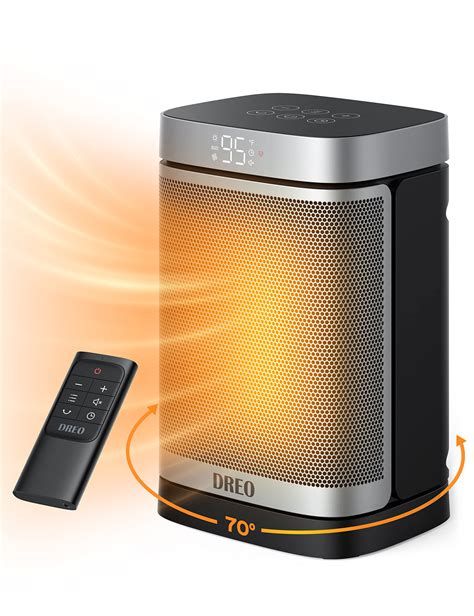
Useful real-world features observed during testing include a programmable timer (helpful for morning warmth), a memory function that restores the last setting after a power interruption, and an adjustable fan speed that balances heat output with noise. For users who wake easily, a low-noise night mode is especially valuable in bedrooms.
Noise and comfort
Noise level is a frequent concern when adding any fan-assisted heater to a bedroom or office. The Dreo 714 runs quieter on low and medium settings, making it acceptable for background use while working or watching TV. On high, the fan speed is more noticeable but remains less obtrusive than many budget fan heaters. The author found the low setting suitable for overnight use when paired with the thermostat; it cycles infrequently and keeps the room comfortable without disruptive noise.
Discover deals on Electronics — updated daily.
View Offers →Safety features and build-in protections
Safety is one of the top buyer concerns for portable heaters. The unit includes standard safety features that buyers expect: tip-over shutoff, overheat protection, and a cool-touch exterior in normal operation. These protections are important in households with children, pets, or high-traffic areas. The tip-over sensor cuts power if the heater is knocked over, and overheat protection shuts the unit down if internal temperatures exceed safe thresholds.
Another practical safety element is the automatic shutoff timer and child lock functionality (if present on the model), which prevents accidental changes to settings. Buyers should still follow best practices: keep the heater on a flat surface, away from curtains and flammable materials, and avoid running it continuously on the highest setting for long periods.
Energy efficiency and operating costs
Most portable electric heaters of this size draw up to approximately 1,500 watts on the highest setting, and the Dreo 714 is typical in that regard. That means operating costs depend primarily on the local electricity rate and how long the heater runs. Practical tips to keep costs reasonable include using the thermostat to maintain temperature instead of running high continuously, pairing the heater with good insulation and draft-proofing, and focusing heating on occupied rooms rather than the entire home.
For buyers who monitor bills closely, using the heater to warm a single room for a few hours is often more economical than raising the thermostat on central hea…
Maintenance and long-term reliability
Maintenance for this class of heater is minimal: occasional dusting of the intake and output grilles, ensuring the fan vents are not obstructed, and storing the unit in a dry place in off-season. The reviewer noticed no performance degradation over several weeks of use. Long-term reliability depends on usage patterns, but the construction quality and internal protections contribute to a sense of durability.
Real-world use cases
- Bedroom heating: Provides rapid warm-up before bedtime and quiet overnight operation on low settings with thermostat control.
- Home office: Targeted heating during working hours reduces the need to heat the whole home and minimizes drafts around desks.
- Small living rooms: Works well when placed centrally or near seating areas; oscillation helps distribute warmth.
- Supplemental heat: Useful in homes with spotty central heating or to augment underperforming radiators.
Pros & Cons
- Pros:
- Fast warm-up in small to medium rooms
- Compact, portable design with easy carrying handle
- Digital thermostat and programmable timer for convenience and energy control
- Multiple safety features (tip-over shutoff, overheat protection)
- Quiet operation on low and medium settings suitable for bedrooms and offices
- Cons:
- May not evenly heat large open-plan rooms as effectively as whole-house systems
- Operating costs can be noticeable on the highest setting if used for long periods
- Fan-based heating can feel less steady or "cozy" compared with oil-filled radiators
- Remote or app features depend on model configuration and can add complexity
Comparison: Dreo 714 versus common alternatives
| Feature | Dreo Whole Room Heater 714 | Ceramic Tower Heater (Generic) | Oil-Filled Radiator |
|---|---|---|---|
| Warm-up time | Fast — fan-assisted warm air, effective in minutes | Fast — similar fan-assisted warm-up | Slow — heats the fluid, then the air |
| Noise | Low to moderate (quiet on low) | Moderate (fan audible) | Very quiet (no fan) |
| Energy consumption | Up to ~1,500 W on high (thermostat lowers duty cycle) | Up to ~1,500 W on high | Similar watts, but longer residual heat reduces active run time |
| Portability | High — compact with handle | High — slim tower, easy to move | Lower — heavier but often with wheels |
| Comfort feel | Direct warm air, effective for spot heating | Direct warm air, similar to Dreo | Smoother, radiant warmth, preferred by some for bedrooms |
| Safety features | Tip-over & overheat protection standard | Often included | Generally safe, lower surface temps but heavy |
Buying guide: How to choose the right heater for your needs
Selecting a portable whole-room heater should start with the fundamentals: the size of the area you want to heat, how you plan to use the heater, and what trade-offs (noise vs. speed vs. operating cost) you are willing to accept.
1. Determine the room size and heat requirement
Measure the room and estimate how many BTUs or watts will be needed. For small bedrooms or offices, a 1,000–1,500 W unit is typically sufficient. If heating multiple rooms or a large open-plan area, consider either multiple portable units or a different heating strategy.
2. Decide between fan-forced or radiant (oil-filled) heat
Fan-forced heaters (like the Dreo-style units) warm air quickly and distribute it using a fan. They are good for short-term, targeted heating. Oil-filled radiators warm more slowly but retain heat and run silently.
Shop the latest Electronics picks on Amazon.
Shop Amazon →3. Look for safety features
Mandatory features should include tip-over protection and overheat shutoff. Child-lock settings and cool-touch exteriors are useful for households with kids or pets. If the heater will be used unattended for long stretches, timers and automatic shutoffs add safety and energy savings.
4. Consider controls and scheduling
Digital thermostats and programmable timers reduce wasted energy. Remote control or app integration is convenient but not essential. Ensure the thermostat is reasonably accurate: a heater that overshoots the temperature often will run inefficiently and feel uncomfortable.
5. Noise level matters
If the heater will be used in a bedroom or quiet home office, prioritize models with quiet night modes. Look for user reviews that report noise at different fan speeds to get a realistic sense of background sound during operation.
6. Check real-world user feedback and warranties
Search for user reviews that describe long-term durability, customer service experiences, and how components like the fan or controls hold up over months. A solid warranty and accessible customer support can be decisive if a unit needs replacement parts or troubleshooting.
7. Placement and safety considerations
Place the heater on a level, non-flammable surface and keep it away from drapery, bedding, and furniture. Avoid obstructing air intakes and keep a safe distance from water sources. For households with pets that like to lie near warm appliances, consider additional guarding or a model with lower surface temperatures.
Conclusion
After several weeks using the Dreo Whole Room Heater 714 as the primary supplemental heat source in a small apartment, the switch delivered practical benefits: rapid warm-up for occupied rooms, quiet performance on low settings, and reliable safety protections that made the unit comfortable to use overnight and during work hours. It performs as one would expect from a modern fan-assisted portable heater — faster than oil-filled units for spot warming, quieter than many budget fans on low, and flexible enough to move between spaces.
For buyers who want targeted, on-demand heat rather than whole-house temperature increases, this style of heater is a sensible option. It is especially well-suited to bedrooms, home offices, and situations where central heating is inconsistent or costly to run. As always, prospective owners should match capacity to room size, pay attention to noise expectations, and follow placement and safety guidelines to get the best experience out of any portable heater.